

Last Updated: November 16, 2026
Quick Summary
The best home coffee method depends on your morning, so score each option on taste, time, cleanup and ongoing cost before buying. A reliable starting recipe is a 1:16 ratio, about 18 g of coffee to 288 g of water, weighed on a scale. Adjust grind size and brew time before changing the ratio.
Most home coffee brewers fall into a few camps. Pour-over gives you clean, bright cups. A drip machine is the easiest path. A French press gives a heavier, fuller body. AeroPress sits in between, with a short, forgiving brew and quick cleanup. Each one suits a different morning, and the fastest way to choose your home coffee method is to score yourself honestly on four trade-offs rather than to chase the “best” method.
The four trade-offs that actually decide it are taste, time, cleanup and ongoing cost. Use this matrix as a starting point, then adjust for your own kitchen.
| Method | Taste profile | Active time | Cleanup | Ongoing cost |
|---|---|---|---|---|
| Pour-over cone | Clean, bright, tea-like | 3-4 focused minutes | Toss paper filter, quick rinse | Filters plus occasional cone replacement |
| Drip machine | Even, familiar, medium body | Under a minute of hands-on time | Remove basket, rinse carafe | Filters plus machine upkeep |
| French press | Heavy, rich, full body | About 4 minutes steeping | Rinse wet grounds from the carafe | None beyond coffee |
| AeroPress | Concentrated, adjustable strength | 2-3 minutes | Pop the puck, rinse the chamber | Filters (paper or reusable) |
Read the row that matches your morning, not the one that sounds most impressive. If you want a cup you can sip while getting ready, the drip machine wins on time. If you want to taste a single-origin coffee clearly, pour-over wins on clarity. If you want body and don’t mind rinsing grounds, the French press wins. If you want one compact brewer that travels and forgives small mistakes, AeroPress wins.
A common pattern is that people buy the most complicated brewer first and abandon it within a month. Brew a few cups with the simplest method you already own, note whether you wanted more clarity or more body, and only then upgrade. That single habit prevents most wasted equipment purchases.
Watch out: do not buy a fancy setup before you know which taste you like. A brewer that fights your morning routine will lose to a boring one that fits it.
The coffee-to-water ratio controls how strong your cup tastes. A good starting point is a ratio of about 1:16, meaning roughly 18 g of coffee to 288 g of water. It is a sensible anchor because it leaves room to move in either direction without the cup falling apart.
Weigh your coffee and water with a kitchen scale. Scoops vary too much from day to day to give you a repeatable cup, and volume changes with grind and bean density.
Change one thing at a time so you can tell what made the difference. Ratio changes strength; grind and time change extraction. A cup can be strong and sour at the same time, which means you need to fix extraction before you touch the ratio.
Scaling is where most home brewers drift. The ratio stays fixed; the grams change. For one 240 g mug, use about 15 g of coffee at 1:16. For two mugs, use about 30 g of coffee to 480 g of water. For a 1 L batch, use about 60 g of coffee to 960 g of water and expect a slightly longer brew, because a deeper bed of grounds slows the flow. Keep the ratio constant and scale the numbers, rather than guessing at a bigger scoop.
A simple recipe card keeps this repeatable. Write down the coffee grams, water grams, grind setting, water temperature and total brew time. When a cup tastes off, change one line, brew again, and compare. Logging three or four brews can teach you more about your own setup than a generic chart.
Watch out: doubling the coffee without doubling the water does not make a stronger cup in a useful way; it usually makes a bitter, over-extracted one. Scale both numbers together and adjust the grind only after the ratio is set.
Grind size matters as much as the ratio. Finer grinds extract faster. Coarser grinds extract slower.
If your cup tastes sour, the grind is probably too coarse or the brew too short. If it tastes bitter, the grind is likely too fine or the brew too long. Adjust the grind before you change anything else.
Water heat pulls flavour out of the grounds. Many brewers start somewhere near the upper 90s °C and adjust from there.
Water quality counts too. Tap water with a strong taste or chlorine will show up in your cup. Filtered water is a simple fix that makes a visible difference.
Pour-over is a great first method to learn. Here is a simple recipe:
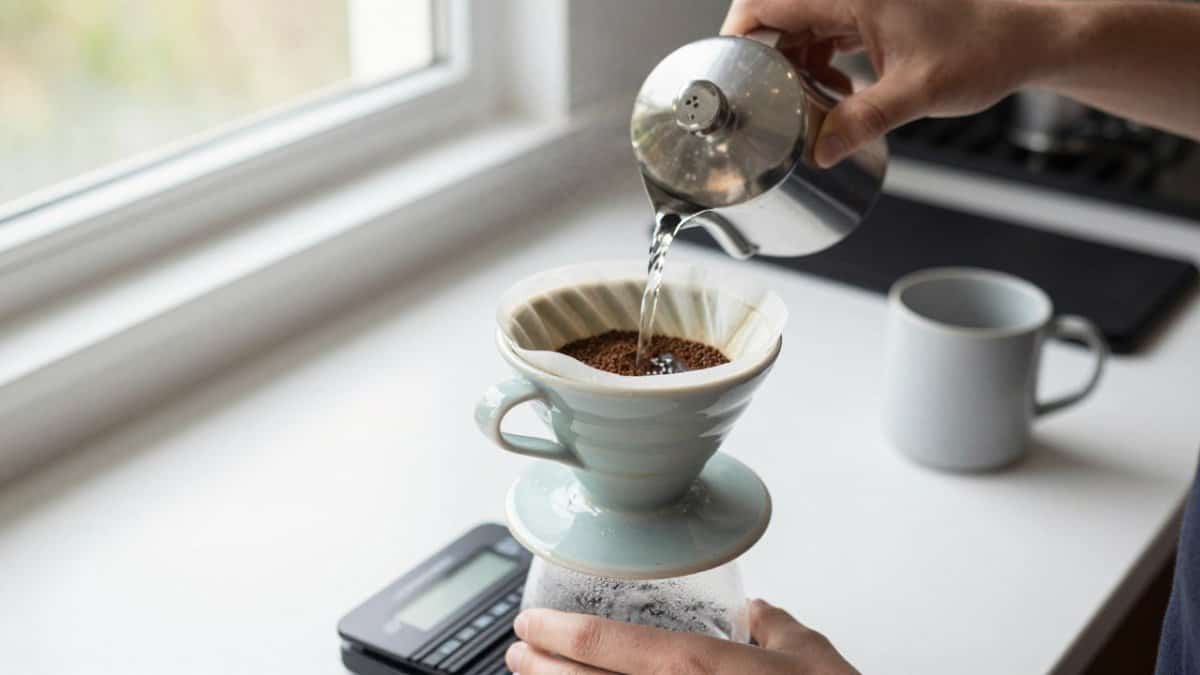
Hands pouring hot water in slow circles over a ground coffee bed in a ceramic pour-over cone on a bright kitchen counter, with a digital scale and a mug nearby.
Brew time depends on the method. Pour-over runs about 2 to 3 minutes. French press steeps about 4 minutes. Drip machines finish in a few minutes on their own.
Use your taste to troubleshoot:
Once your recipe tastes right, write it down. The companion guide walks through turning that recipe into a daily morning habit. Note the grind, ratio, water temperature and brew time. Repeat it for a few mornings to confirm it.
A good cup deserves a good mug. Browse our collection of ceramic mugs with personality and find one that suits your morning. Shop All Mugs at SmugMugs.ca.
The best brew is the one you have actually tasted and tuned. Start with the 1:16 ratio, adjust one variable at a time, and trust your own palate. Your morning cup will get better with every try.
There is no single best method, because the right one depends on the flavour you want, how much time you have and how much cleanup you will tolerate. Pour-over and drip brewers suit people who want a clean, bright cup with little effort. A French press gives a heavier body and needs only a coarse grind and a few minutes of steeping. Start with the method that matches your morning routine, then adjust the ratio, grind and brew time until the cup tastes right to you.
A useful starting point is 18 g of coffee to 288 g of water, which is about 1:16. Treat these numbers as a baseline rather than a rule. If the coffee tastes weak, use slightly more coffee, and if it tastes harsh or bitter, use a little less or grind a touch coarser.
Grind size should follow contact time. Coarse grounds suit French press and longer steeps, medium grounds suit drip machines and standard pour-over, and fine grounds suit short, pressurised methods. If your coffee tastes sour and thin, the grind is probably too coarse. If it tastes bitter and dry, it is probably too fine. Change one variable at a time so you can tell which adjustment made the difference.
A drip coffee maker or a simple pour-over cone is usually the easiest starting point. Both need few tools, produce consistent results once the ratio is set, and clean up quickly. A French press is also forgiving, though it leaves sediment and needs more care when pouring. Choose based on whether you want a hands-off routine or more control over each step.


