
Last Updated: October 1, 2026
Do ceramic mugs fit coffee machines? Sometimes yes, sometimes no, and the difference comes down to two measurements most people never take. A standard ceramic mug is often too tall, too wide at the base, or both for a machine built around a travel cup. This guide from SmugMugs.ca walks through the clearance numbers, the base diameter rule, and the mug features that actually matter.
Here’s the frustrating part: mug makers and coffee machine makers don’t talk to each other. There’s no shared standard. So a mug that looks perfect on a shelf can jam under a group head or wobble on a drip tray. Below, we’ll show you exactly how to measure your machine in under a minute, plus what to look for if you want a mug that pours clean every morning.
The good news? Once you know your machine’s numbers, choosing a mug becomes easy. Most fit problems trace back to a single spec you can check in seconds.
Espresso machine clearance height is the vertical distance between the group head and the drip tray, and it’s the number that decides whether your mug fits. On many home machines, that gap is tight by design. It’s built for a demitasse, not a chunky ceramic mug.
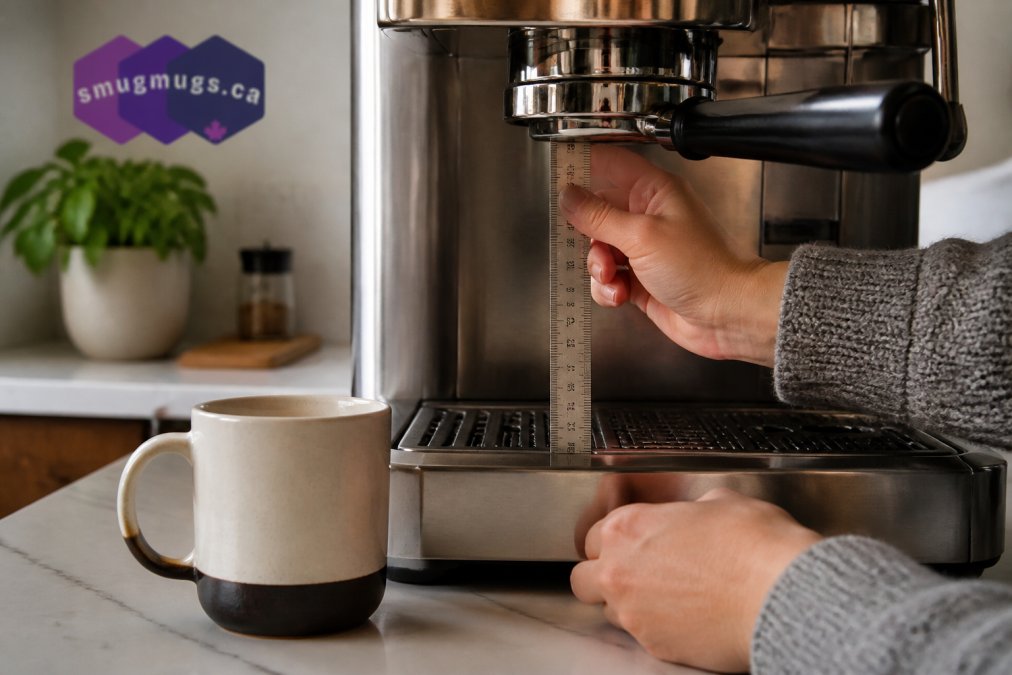
Here’s the catch most buyers miss: some drip trays are removable. Pop the tray out and you gain real clearance.
That final number is your real clearance. A mug taller than it will hit the spout or sit crooked. A mug shorter than it works fine. Simple as that.
Most home espresso machines fall into predictable clearance ranges. Knowing where yours sits tells you immediately whether a standard ceramic mug will work.
| Machine Type | Typical Clearance (Group Head to Drip Tray) | Fits Standard Ceramic Mug? |
|---|---|---|
| Compact manual espresso (e.g., 3-cup class) | 6-8 cm | No, demitasse only |
| Mid-range pump espresso | 8-10 cm | Sometimes, short mugs only |
| Full-size home espresso | 10-13 cm | Yes, most standard mugs |
| Commercial-style home unit | 13-16 cm | Yes, large mugs and travel cups |
A mug can clear the group head vertically and still fail. The base diameter determines whether the mug sits stable on the drip tray or wobbles with every pour.
Many home espresso machines, including several popular Breville and De’Longhi models, have drip trays that lift out completely. Removing the tray can add 2-4 cm of clearance, which is often enough to fit a standard ceramic mug that would otherwise be too tall.
Health Canada guidance on food-safe ceramics and glazes
For drip coffee machines, measure the distance from the warming plate to the brew basket outlet. That gap is usually more generous than an espresso machine’s, but wide carafes and tall travel mugs still cause trouble. Grab a ruler, set it on the plate, and measure straight up to where the coffee drips out.
Base diameter matters as much as height, and almost no guide mentions it. A mug with a wide base can cover the drip tray holes or overhang the warming plate. That means spills pool instead of draining, and the mug sits unstable while you pour.
The best ceramic mugs for coffee makers share a few traits: a moderate height, a base that fits standard trays, and a handle that clears the machine body. You don’t need a specialty mug. You need one with the right proportions.
Look for these:
Ceramic lining and stainless steel each win in different situations. Ceramic keeps flavors clean and won’t leave a metallic aftertaste, which matters if you drink tea or black coffee. Stainless steel holds heat longer and survives drops that would crack ceramic.
Here’s the trade-off in plain terms:
| Feature | Ceramic Lining | Stainless Steel |
|---|---|---|
| Flavor | Clean, no metallic taste | Can taste metallic |
| Heat retention | Moderate | High |
| Durability | Can chip if dropped | Dent-resistant |
| Best for | Coffee and tea purists | Commuters on the move |
A mug is only useful if it survives daily life. That means a leakproof lid if you carry it, dishwasher-safe materials if you hate hand-washing, and enough heat retention to keep your drink warm past the first sip.
Run through this before you buy:
This is the part most buying guides skip. Ceramic coatings on mugs, especially the glazed interior, are not indestructible. Two forces wear them down over time: thermal shock and mechanical abrasion.
Ceramic is a moderate insulator. It holds heat longer than thin glass but shorter than double-walled stainless steel. For a mug you drink from at your desk, that’s usually fine, you’ll finish the coffee before it goes cold.
“Dishwasher safe” on a ceramic mug means the glaze and any applied decals can survive normal dishwasher cycles without fading, cracking, or leaching. It does not mean the mug is indestructible.
In Canada, ceramic foodware is regulated under the Canada Consumer Product Safety Act (Industry Guide to the Glazed Ceramics and Glassware Regulations). Mugs sold for food use must not leach lead or cadmium above set limits. Reputable manufacturers test their glazes and label them accordingly.
Health Canada information on lead in consumer products
The biggest mistake is buying on looks alone. A mug can be gorgeous and still not fit. Measure your machine first, then fall in love with a design that actually works.
Other traps to avoid:
Fit comes down to two numbers: clearance height and base diameter. Measure both, and you’ll never buy a mug that jams under the spout again.
Look for a travel mug under 14 cm tall with a base diameter between 6 and 8 cm. Ceramic mugs with a tapered base tend to slide onto drip trays more easily than wide, straight-sided ones. Check that the lid is leakproof if you plan to commute with it. SmugMugs.ca carries ceramic vessels in a range of sizes, so measure your machine’s clearance first, then match the mug dimensions to that number before ordering.
Ceramic mugs are heavier than stainless steel or plastic, and they can chip if dropped on a hard surface. They also lose heat faster than vacuum-insulated options because the ceramic wall does not trap a vacuum layer. Most ceramic mugs are not leakproof without a lid, so they are better for desk use than for tossing in a bag. On the plus side, ceramic does not hold onto metallic aftertaste the way some stainless steel interiors can, and it is dishwasher safe if the glaze is rated for it.
Place a ruler upright on the drip tray directly under the group head or brew spout. Measure from the tray surface to the lowest point where the mug would hit. Subtract 1 cm as a safety buffer. That number is your maximum mug height. For drip coffee machines, also measure the width between the brew basket and the machine’s back wall to confirm the mug’s base diameter fits without wobbling.
Both are kiln-fired clay, but porcelain fires at a higher temperature, making it denser and slightly more chip-resistant. Ceramic is more porous and holds heat a little longer, which suits slow sipping. For coffee machine fit, the difference is negligible; what matters is height, base diameter, and whether the glaze is lead-free and food-grade. Choose based on feel and design, not on which one fits better under a group head.


