

Last Updated: September 16, 2026
A mug is the one object you touch before you’re fully awake, and a bad one ruins the ritual. At SmugMugs.ca, we’ve handled enough ceramic to know that how to spot quality ceramic mugs comes down to a handful of physical tests you can run in under a minute, no lab required. This guide walks through clay bodies, glaze safety, surface flaws, handle ergonomics, and heat behavior so you can judge a mug before you commit to it.
Porcelain and stoneware are the two dominant clay bodies for drinking vessels, and each wins on different criteria. Porcelain is fired hotter and denser, giving it a smooth, chip-resistant surface and a lighter feel in the hand. Stoneware is fired at lower temperatures, leaving it heavier, more textured, and generally better at holding heat.
| Clay Body | Firing Range | Weight | Heat Retention | Best For |
|---|---|---|---|---|
| Porcelain | High-fire | Light | Moderate | Thin rims, everyday use |
| Stoneware | Mid to high-fire | Heavy | Strong | Slow sipping, hand-thrown feel |
| Earthenware | Low-fire | Medium | Weak | Decorative pieces, light use |
The reliable way to check for lead in ceramic mugs is to buy from a maker who states the glaze is lead-free, then confirm the finish is fully vitrified and uncracked. Lead glazes were historically common because they produce bright, glossy color at low cost, and they remain a real risk in cheap imports and vintage pieces.
Here’s what actually works:
Visual inspection is where most buyers stop at a glance. The useful version is a sequence: look at the interior first, then the rim, then the base, then the handle join, and only then the exterior decoration. Each zone fails in a different way.
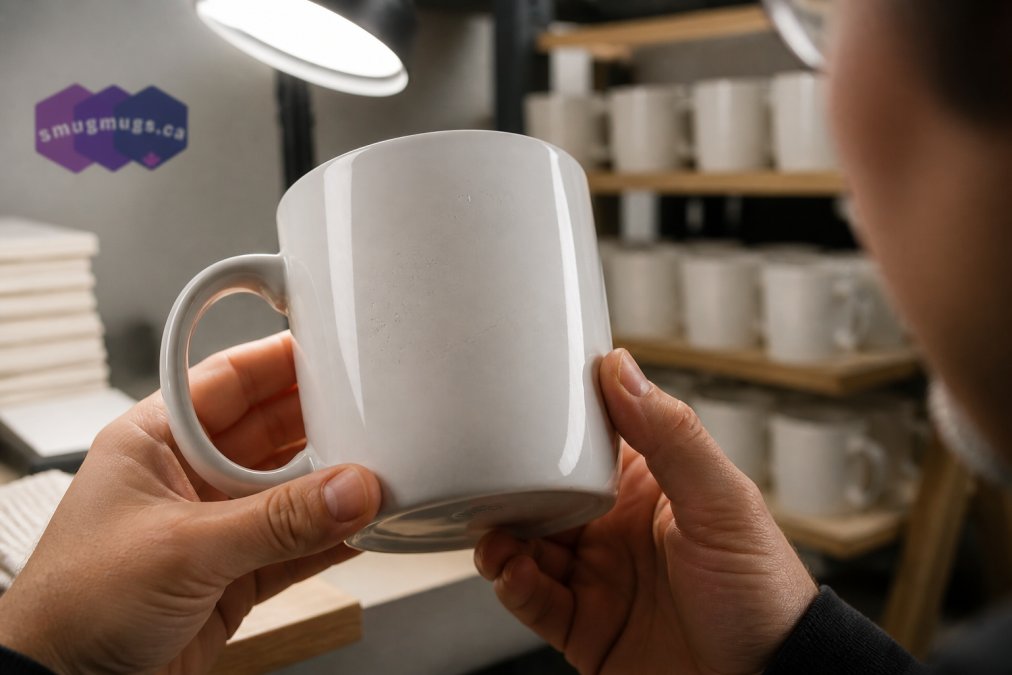
A jeweler’s loupe or a phone macro lens turns mug inspection from guesswork into evidence. Under magnification, a healthy glaze looks continuous and glassy, with color that sits in the surface rather than on top of it. Under the same lens, a cheap glaze shows pinholes clustering near the rim, uneven glaze consistency, and faint crazing that’s invisible at arm’s length.
A practical magnification routine:
Tapping a mug is a classic artisan method that most digital guides skip. Hold the mug by the handle, flick the rim with a fingernail, and listen. A sound, well-fired body rings clear and sustained. A cracked, crazed, or under-fired body gives a dull thud or a short, flat note. The difference is obvious once you’ve heard both side by side.
Pick the mug up empty, then fill it and pick it up again. A well-made ceramic mug feels balanced when full, with the handle positioned so the weight sits over your fingers rather than pulling at your wrist. Handles attached with a clean, fully glazed seam hold up; handles with a visible gap or a rough join are a weak point waiting to snap.
Check three things:
Heat retention comes from wall thickness and the density of the fired clay. Thick stoneware walls hold temperature longer, which is why a heavy mug keeps coffee drinkable through a long meeting. Thin porcelain loses heat faster but feels more elegant and heats up quicker when you pre-warm it.
The ping test does double duty. It reveals hairline cracks, and it tells you something about firing quality. A high, clear ring suggests a dense, well-vitrified body. A flat, short note suggests porosity, under-firing, or a crack. Most practitioners find that the difference is unmistakable after comparing a few mugs side by side.
Pre-warming a mug with hot tap water before you pour coffee is the single easiest way to extend drinkable temperature, especially with thin porcelain. Thick stoneware needs less pre-warming because its mass holds heat, but it also takes longer to warm through. If you drink slowly, stoneware wins. If you drink quickly and want a lighter feel, porcelain with a pre-warm is the better trade.
“Dishwasher safe” and “microwave safe” are claims, not guarantees, and they’re applied loosely. A mug can survive the dishwasher but still lose its glaze sheen over hundreds of cycles, and metallic or hand-painted decoration can degrade in the microwave even when the body is fine.
Use this as your practical rule set:
The best cool coffee mugs are the ones that still look and feel right after a year of daily use, and that comes down to everything above: a vitrified body, a lead-free glaze with no crazing, a handle that fits your hand, and walls thick enough to hold heat. Buy for the build, then pick the design that makes you grin.
Check the glaze for smoothness and consistency. Look for pinholes, crazing, or hairline cracks. A quality ceramic mug feels balanced, has a comfortable handle, and rings clear when tapped. The base should be unglazed or fully vitrified. High-fire stoneware or porcelain mugs resist chipping better than earthenware. Also verify food-safe and lead-free labeling, especially for mugs made overseas.
Yes. Porcelain is fired at higher temperatures, making it denser, lighter, and more chip-resistant. Stoneware is heavier, more rustic, and retains heat longer. Both are durable, but porcelain suits daily office use where weight matters. Stoneware works well for slow morning coffee. Neither is inherently better; it depends on your priorities for weight, heat retention, and feel.
Look for a lead-free or food-safe label. Avoid mugs with metallic or brightly colored interior glazes unless verified. Test kits can detect lead, but the most reliable method is buying from brands that publish safety certifications. In Canada, ceramic drinkware should meet Health Canada guidelines for food contact surfaces. If a mug has no safety information, treat it as decorative only.
Watch for pinholes, bubbles, or uneven texture. Crazing (fine web-like cracks) indicates thermal expansion mismatch and can harbor bacteria. A glaze that feels rough or sticky, or that fades after washing, signals low firing temperature. Also check for color bleeding near the rim. Quality glaze is smooth, uniform, and fully bonded to the clay body.
Weight affects balance and comfort. A mug that is too light may feel fragile and tip easily. Too heavy and it strains your wrist during daily use. The ideal mug feels substantial but not burdensome. Weight also hints at density and vitrification: denser mugs retain heat longer. For office use, aim for a mug that feels solid but lets you drink comfortably.
The handle should fit at least two fingers comfortably without pinching. Check attachment points where the handle meets the body; smooth, seamless joins resist cracking. A well-attached handle supports the mug’s weight without flexing. Thicker handles suit larger hands; thinner ones work for smaller grips. Avoid handles with visible gaps or rough patches at the joint.


