

Last Updated: September 20, 2026
The price tag on a mug can range wildly. A basic ceramic vessel from a big-box store costs a few dollars. A handcrafted artisanal piece might run you several times more. But here’s the thing: expensive mugs aren’t expensive just because someone decided to charge more. There are real, tangible reasons why some mugs command premium prices, and understanding those reasons is the first step in figuring out whether are expensive mugs worth the price for your situation.
The real question isn’t whether expensive mugs are objectively “worth it”, it’s whether they’re worth it for you, based on how you use mugs and what you value. That’s what we’ll explore throughout this guide.
The material your mug is made from is the foundation of everything else. These three materials look similar but perform very differently, and the cost differences between them are substantial.
Porcelain is fired at the highest temperatures, making it the densest and hardest of the three. It’s chip-resistant, non-porous, and won’t absorb flavours or stains over time. Porcelain mugs are typically the lightest in weight. The manufacturing process is more precise and requires tighter quality control, which is why porcelain commands a premium price.
Ceramic is a broader category that includes earthenware and stoneware. True ceramic is fired at lower temperatures than porcelain, making it slightly more porous. It’s durable for everyday use but can chip more easily and may absorb subtle flavours if used heavily. Ceramic mugs often have better heat retention than porcelain because the material is slightly thicker to compensate for lower density.
Stoneware sits in the middle. It’s fired at moderate-to-high temperatures, creating a non-porous, durable surface. Stoneware mugs tend to be heavier and thicker than both porcelain and ceramic. They excel at heat retention and feel substantial in your hand. The tactile experience of holding a stoneware mug is often what people pay extra for.
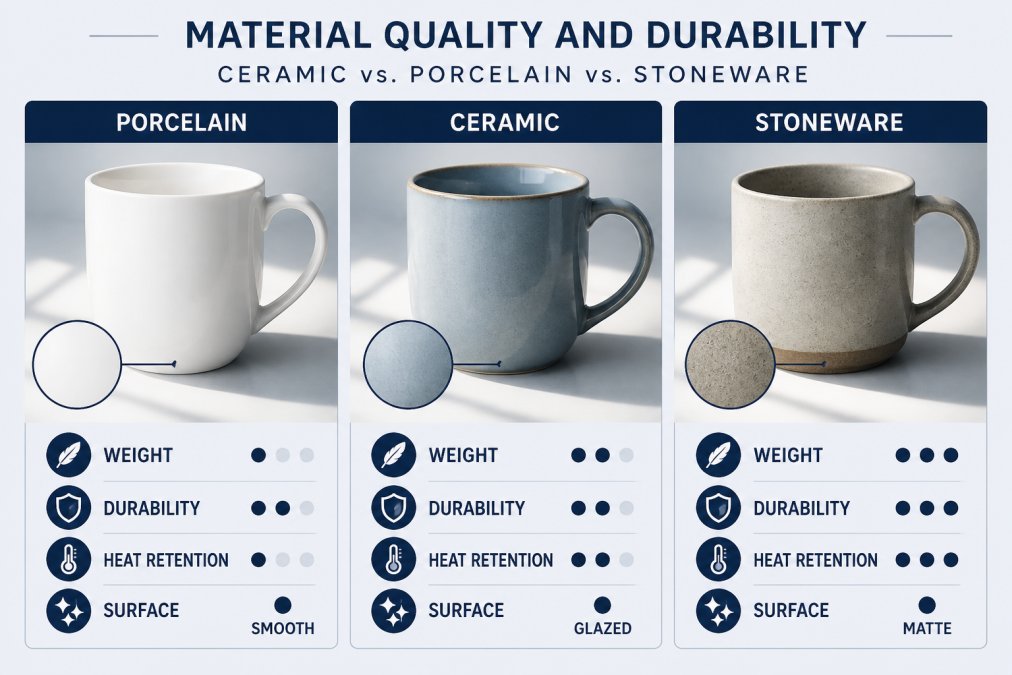
Here’s the practical difference: if you want a balanced option that’s affordable and reliable, ceramic works fine.
Choosing a high-quality mug means looking beyond the brand name and price tag. Several specific factors determine whether you’re getting real value or just paying for marketing.
Weight and thickness are your first clues. Pick up the mug. Does it feel substantial? A quality mug has walls that are roughly consistent in thickness. Thin-walled mugs feel cheap and cool down faster. Thick-walled mugs retain heat longer and feel more durable. The rim should be slightly thicker than the body for durability, this is where chips typically start.
Glaze quality matters more than most people realize. Run your finger along the inside and outside. Does the glaze feel smooth and consistent, or are there rough spots or inconsistencies? A well-executed glaze protects the underlying material and prevents staining. Poor glaze application leads to mugs that discolour and absorb odours quickly.
Handle design directly impacts daily usability. The handle should distribute weight evenly and feel comfortable in your hand. If your fingers feel cramped or the handle feels flimsy, you’ll resent using that mug. A well-designed handle adds significantly to manufacturing cost because it requires precision molding and attachment.
Base stability is easy to overlook. Place the mug on a flat surface. Does it sit flat, or does it rock slightly? A mug with an uneven base is poorly finished and more likely to tip. Quality manufacturers invest in precision finishing to ensure the base is perfectly flat.
Microwave and dishwasher safety should be verified. Check the bottom or packaging. Not all premium mugs are dishwasher safe, and some glazes can be damaged by microwave heat. If you plan to use the mug heavily, this matters for long-term value.
This is where opinions diverge sharply. Handmade mugs cost significantly more. Mass-produced mugs are consistent and affordable. Which is actually better?
Mass-produced mugs are made with molds and automated systems. Consistency is the goal. Every mug is identical. Quality control happens at scale, which means defects are caught statistically rather than individually. The cost per unit is dramatically lower because labour is minimal and materials are bought in bulk.
Here’s the honest assessment: a mass-produced mug from a reputable manufacturer is perfectly fine for everyday use. It won’t be as beautiful or unique, but it will work.
The real question is whether are expensive mugs worth the price when you value the uniqueness and superior craftsmanship enough to justify the cost difference. If you use your mug daily and appreciate quality, handmade wins. If you just need something functional, mass-produced is fine.
This is where expensive mugs actually earn their price through measurable daily benefit.
Heat retention depends on material thickness and density. Ceramic mugs keep drinks warm for 30-45 minutes. Thin ceramic might only manage 20 minutes. If you drink slowly or take breaks between sips, heat retention matters. If you drink fast, it doesn’t.
Ergonomics are about how the mug feels in your hand over time. A handle that’s too small causes hand fatigue. A handle that’s too large is awkward to grip. The weight distribution matters, if the mug is too heavy, your wrist gets tired. If it’s too light, it feels cheap. A well-designed mug distributes weight evenly and supports your hand naturally.
Daily performance includes dishwasher durability, microwave safety, and resistance to staining. A premium mug should survive hundreds of dishwasher cycles without degradation. The glaze shouldn’t crack. The handle shouldn’t loosen. Budget mugs often fail these tests within a year or two.
Thermal efficiency is a technical term, but the practical meaning is simple: does the mug keep your drink at a pleasant temperature while you’re actually using it? A mug with poor thermal efficiency forces you to reheat frequently. A mug with good thermal efficiency means fewer trips to the microwave.
The durability of a mug depends partly on how you treat it. Even an expensive mug can fail quickly with poor maintenance.
Hand washing is gentler than the dishwasher, especially for handmade or delicate pieces. If you want a mug to last 10+ years, hand wash it. The dishwasher is convenient, but the heat and agitation wear mugs down faster.
Avoid thermal shock by not moving a hot mug directly to cold water or vice versa. Rapid temperature changes can cause the glaze to crack or the material to chip. Let mugs cool naturally before washing.
Store carefully to prevent chipping. Don’t stack mugs directly on top of each other without protection. Use felt pads or cloth between stacked mugs. The rim is the most vulnerable part.
Clean the rim gently. The rim is where most chips start. When washing, use a soft cloth or sponge around the rim rather than abrasive scrubbers.
Inspect regularly for hairline cracks in the glaze. A tiny crack can expand over time, especially if the mug is used for hot liquids. If you spot a crack, stop using the mug.
This is the calculation that actually matters.
But here’s the reality: most people don’t use the same mug every single day for years. They rotate through several mugs. They break one and buy a replacement. The actual cost-per-use calculation is messier than the math suggests.
For daily users who care about the experience, expensive mugs are worth it. The better heat retention means fewer reheats. The better ergonomics mean less hand fatigue. The superior glaze means no staining or flavour absorption. These are real daily benefits that accumulate over time.
For occasional users or people who rotate through many mugs, a budget option is fine.
| Mug Type | Typical Cost | Expected Lifespan | Uses Per Year | Cost Per Use (10 years) |
|---|---|---|---|---|
| Budget ceramic | Lower | 3-4 years | 365 | Higher per year of ownership |
| Standard ceramic | Moderate | 5-7 years | 365 | Moderate |
| Premium stoneware | Higher | 10+ years | 365 | Lower over extended period |
| Handmade artisanal | Highest | 10-15 years | 365 | Varies by usage intensity |
Expensive mugs aren’t expensive because of a pricing scheme. They’re expensive because better materials, tighter manufacturing tolerances, superior design, and longer lifespan actually cost more to produce. Whether that premium is worth it depends entirely on how you use mugs and what you value in the experience.
Durability depends on material and construction, not just price. A well-made ceramic mug can outlast a poorly glazed one. The real difference emerges after 2-3 years of daily use: premium mugs maintain their finish and structural integrity, while cheaper alternatives may develop hairline cracks or glaze deterioration.
Heat retention depends on material thickness and insulation design, not brand prestige. Ceramic mugs are poor insulators compared to vacuum-sealed stainless steel. However, ceramic provides better flavour because it doesn’t impart a metallic taste. Choose based on your priority: maximum heat retention favours insulated metals, while flavour and tactile experience favours premium ceramic.
Handmade ceramic mugs command higher prices due to artisanal craftsmanship, unique glazing, and lower production volumes. Each piece is individually kiln-fired, resulting in subtle variations that factory mugs cannot replicate. Handmade mugs typically feature thicker clay bodies, hand-finished details, and food-safe glazes applied with precision. They also support small makers and traditional pottery techniques. The trade-off: handmade pieces may have minor imperfections and require more careful handling, but they often become cherished daily-use items rather than disposable vessels.
Evaluate mugs using three criteria: material composition (high-fire ceramic performs well), weight and balance (heavier mugs with lower centres of gravity feel better in hand), and surface finish (smooth glazes resist staining and crazing). Check the rim thickness, thin rims chip easily, while thicker rims last years. Premium mugs also make better gifts because they feel intentional and reflect the giver’s thoughtfulness.


